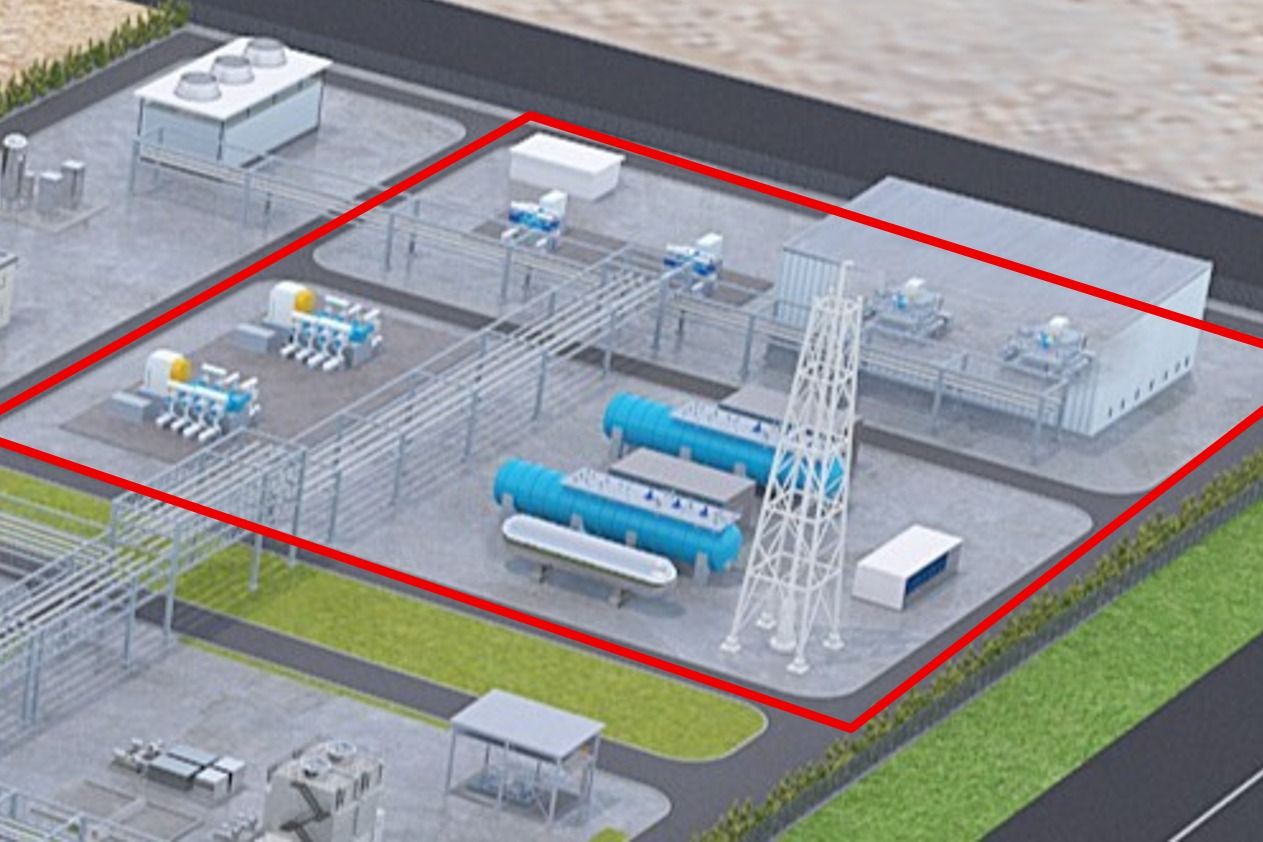
The primary purpose of the ETU is to generate the engineering data needed to design the company’s first commercial pilot plant.
The ETU allows continuous cycling between the hydrogen producing oxidation reaction and, without interruption, the reduction reaction resulting ultimately in oxygen production.
“Continuous operation is where an engineering team learns how a process actually behaves over time,” said Ryan Patrick, NewHydrogen’s Senior Chemical Engineer, who led the ETU construction effort and is overseeing its operation. “The data we collect from the ETU will be used to design and determine the specifications for our first commercial pilot plant.”
Using results from an ETU is the standard, industry-accepted pathway for designing a commercial pilot plant. NewHydrogen’s ETU serves as the bridge between its bench scale laboratory experiments and its first commercial pilot plant, purpose-built to characterise the process performance and kinetics of ThermoLoop under continuous, repeatable operating conditions.
This milestone builds on the company’s previous announcement that it would automate the ETU’s controls, a step designed to give NewHydrogen’s engineering team continuous testing capability with greater precision and repeatability from run to run. With construction and commissioning now complete, NewHydrogen will use the resulting data from long duration operation of the ETU to define the specifications for its first commercial pilot plant. A successful pilot plant will provide the basis for the ultimate commercial application: an industrial scale ThermoLoop facility built to meet the needs of the clean hydrogen market.
Demand for Massive Amounts of Clean Hydrogen
Clean hydrogen demand is now measured in gigawatts, not megawatts. These industrial scale systems are defined as 1 GW or greater, the level at which hydrogen can meaningfully displace fossil fuels in the industrial marketplace.
Present production methods have not been built for that scale. Worldwide installed electrolysis capacity totalled only about 4 GW in 2025, spread across many small and mid-sized projects rather than integrated, single gigawatt-scale plants, even as announced project pipelines have reached into the hundreds of gigawatts. ThermoLoop is designed from the outset to close that gap.
The NewHydrogen industrial scale base case system assumes production capacity of 200 000 tpy of hydrogen. This scale represents a major industrial plant, roughly equivalent to a 1.5 - 2 GW dedicated electrolysis plant or a large commercial steam methane reforming (SMR) facility.
The market ThermoLoop is built to serve already exists at enormous scale, but currently relies on fossil fuel feedstock, usually natural gas. Instead, ThermoLoop uses heat to split water to produce clean hydrogen.
“Our ETU is the foundation for everything that comes next. With the unit built and commissioned, we can now cycle ThermoLoop continuously and demonstrate the long duration stability of the process, which will generate the engineering data that will define our first pilot plant. From there, a pilot plant can scale to major industrial plants needed to meet the demands of an eager market,” said Steve Hill, CEO of NewHydrogen.